Members of the Jamestown Rotary Club were fortunate to hear from several notable guests during the club’s weekly meeting at the end of September, as well as throughout the month of October.
These guests included the President and CEO of Hart Hotels, the Governor of Rotary District 7090, a long-time Rotarian and local business owner with a passion for local history, and another local Rotary Club member who also serves as the head of the United Way of Chautauqua County, which helps thousands of people across the region, including here in Jamestown.
 On September 29, the Rotary Club of Jamestown welcomed David Hart, president and CEO of Hart Hotels, as its guest speaker. Hart Hotels owns and operates the Chautauqua Harbor Hotel in nearby Celoron and is celebrating its 40th year in business.
David has an estimated 40 years of experience in developing, operating, and managing hotels and restaurants. Under his leadership, Hart Hotels operates 13 hotels with 2,000 hotel rooms in New York, Massachusetts, Connecticut, and Texas. David was born and raised in Buffalo and received his degree in Business Administration from SUNY Buffalo. In the year 2000, he was inducted into the Buffalo State University Athletics Hall of Fame for his involvement in the school's basketball program. He is also a member of the inaugural class of Leadership Buffalo.
As part of his presentation, David shared a brief history of his family's involvement in the hotel and hospitality industries. He said his father, William Hart, came to Buffalo with his parents after World War II. After military service, he studied civil engineering on the GI Bill and soon found work with a Construction Company that won a bid to build four Holiday Inn franchises in Western New York in the early 1960s for Belz Enterprises, a franchisor of Holiday Inns. The Belz family was so pleased with William's work that they hired him to oversee the construction of eight more hotels. In 1977, he became president of the Belz hotel management company and in 1985, William started Hart Hotels with the purchase of four local Holiday Inns from his partners.
David became involved in the hotel industry in 1983, working at the Holiday Inn in White Plains, NY as manager. Two years later, when his father started Hart Hotels, David joined his team and worked to help manage the four Holiday Inns located in Buffalo. When his father retired in 1992, David took over as president and CEO and has held that position ever since.
In 2016, Northwest Bank approached Krog and Hart Hotels about developing a Harbor Hotel in Celoron, on land that the bank had recently acquired through foreclosure. With the help of the County of Chautauqua Industrial Development Agency (CCIDA) and Empire State Development (ESD), the project moved forward with ground being broken in 2017. In 2018 the Chautauqua Harbor Hotel was completed and opened for business. David said that without the business assistance from the CCIDA and ESD, the project would not have been able to move forward.
David also talked about giving back to the community and supporting charity. He said that since 2009, Hart Hotels has raised more than $600,000 for various causes, including the Child Advocacy Program (CAP), which benefits locally from the annual Fire & Ice fundraiser at the Chautauqua Harbor Hotel. He said that the hotels also serve as an economic engine for their local communities, with the three Harbor Hotels in New York State being located in less populated areas, compared to those in larger cities. He indicated that between the three Harbor Hotels in New York State, the annual payroll is $9 million.
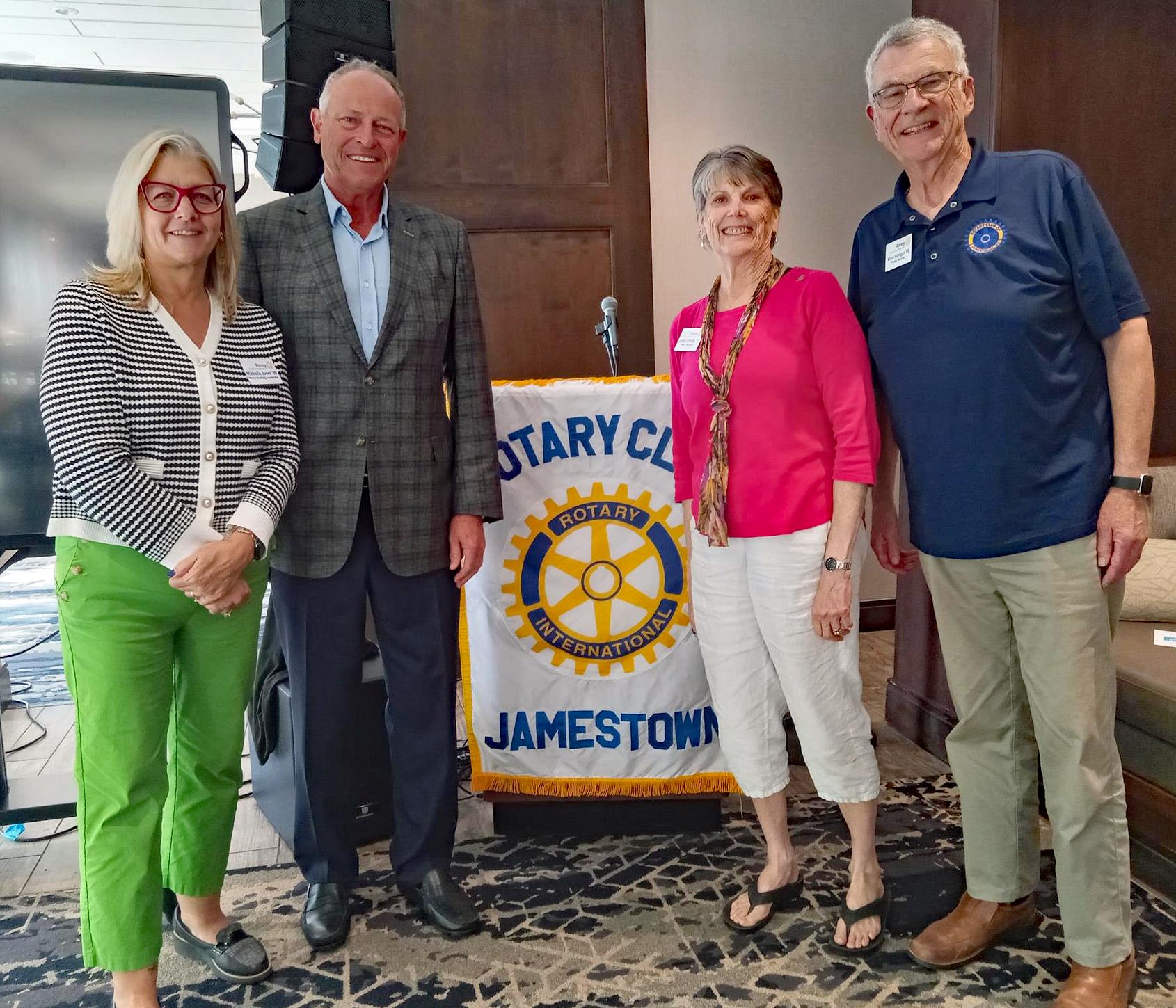
PHOTO (L to R): Michelle Jones, Rotary Club of Jamestown president; David Hart, president and CEO of Hart Hotels, Caitlin O’Reilly, Jamestown Rotary President Elect; and Vince Horrigan, Program Committee member who introduced Mr. Hart.
 On October 6, Aaron Carlson, District 7090 Governor, met with the Jamestown club. Aaron, who is originally from Dallas, is a member of the Rotary Club of Lockport and serves as pastor of University United Methodist Church in Syracuse. He has served as club president and Rotary Foundation chair and membership chair for his club. He moved to New York about 14 years ago. When he arrived in New York, he was encouraged to join Rotary to get to know people and make connections.
Aaron began his comments by saying this is a unique Rotary year. After he was elected DG, he was moved by his denomination to Syracuse, a different Rotary district. He agreed to stay on as DG and remain in his Lockport Club for the remainder of his term.
Aaron explained to the Jamestown Rotarians that this year there is no “theme” but rather a Presidential Message which encompasses the Rotary Action Plan. The phrase “Rotary Unites for Good” has been utilized. The Action Plan included: Increasing Rotary’s impact and Expanding Rotary’s Reach. Aaron asked for input from the club on these facets of the plan. Members from our club shared things like partnering with other clubs, doing hybrid meetings, corporate memberships, and once a month social events – all things we do on a regular basis. He referred to the Jamestown Club as a flagship club and was excited to share some of our implementations with other clubs!
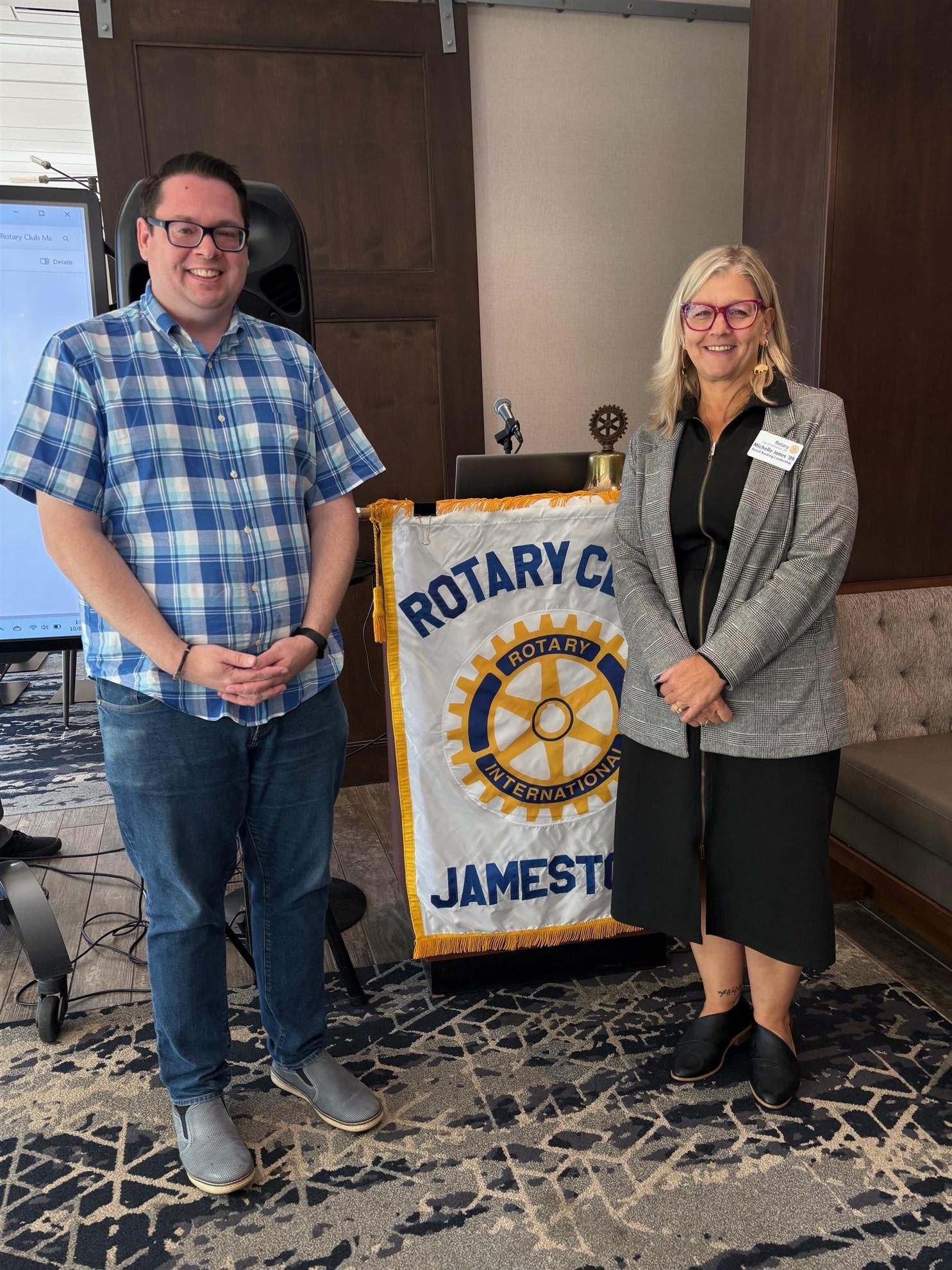
PHOTO (L to R): Aaron Carlson, Rotary District 7090 Governor and Michelle Jones, Rotary Club of Jamestown president.
 On October 20, fellow Rotarian Mark Olson spoke to the club. A member of the Jamestown Rotary Club for 39 years, Mark is the president and founder of Axiom Office Imaging in Jamestown.
Mark chose to talk about the early oil industry in nearby Northwest Pennsylvania for his presentation, focusing on two notable boomtowns—Pithole, PA and Balltown, PA. The oil industry in this pat of the country began in the mid-19th century after Edwin L. Drake’s 1859 oil strike in Titusville, PA, which sparked the world’s first commercial oil boom. The quiet farmlands of Pennsylvania rapidly transformed into the center of a new global energy era.
Pithole, PA, established in 1865, became one of the most dramatic boomtowns in U.S. history. Within months of oil discovery by Isaiah Frazier and John Grandin, its population exploded to over 15,000 residents, complete with hotels, theaters, newspapers, and a stock exchange. However, by 1868, the wells had dried up and the town was abandoned—a lasting reminder of the volatility of resource-based economies. Today, Pithole is preserved as a National Historic Site, symbolizing both the promise and impermanence of early industrial opportunity.
Nearby Balltown, PA played a quieter, yet crucial, role. It was home to independent drillers and early refiners experimenting with crude extraction and pipeline systems—innovations that became the foundation of modern oil exploration and refining.
Together, these towns and the oil fields of Southwest Pennsylvania mark the birthplace of the American oil industry, shaping global energy markets and pioneering technologies that transformed transportation, manufacturing, and modern civilization. Mark concluded his talk by encouraging members to explore these historic sites and connect with him for further discussion.
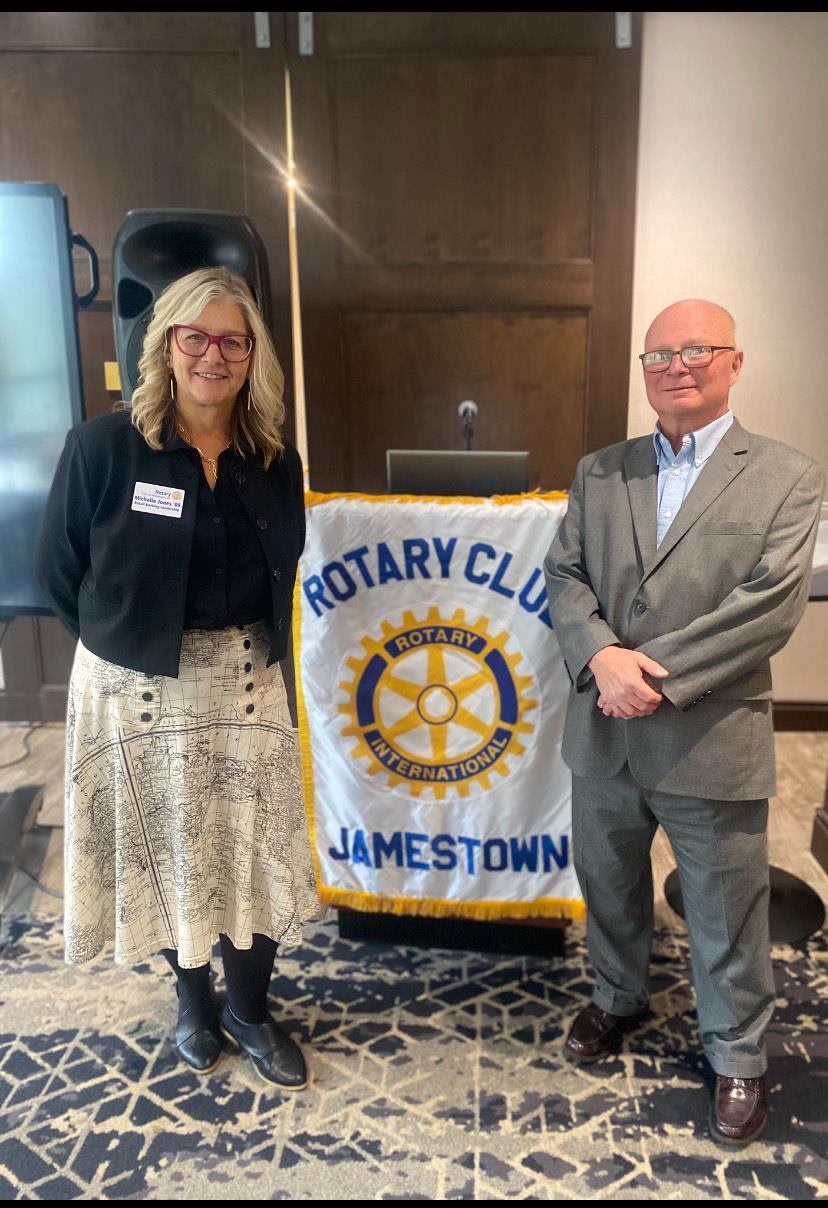
PHOTO (L to R): Michelle Jones, Rotary Club of Jamestown president and Mark Olson, Rotarian and October 20 guest speaker.
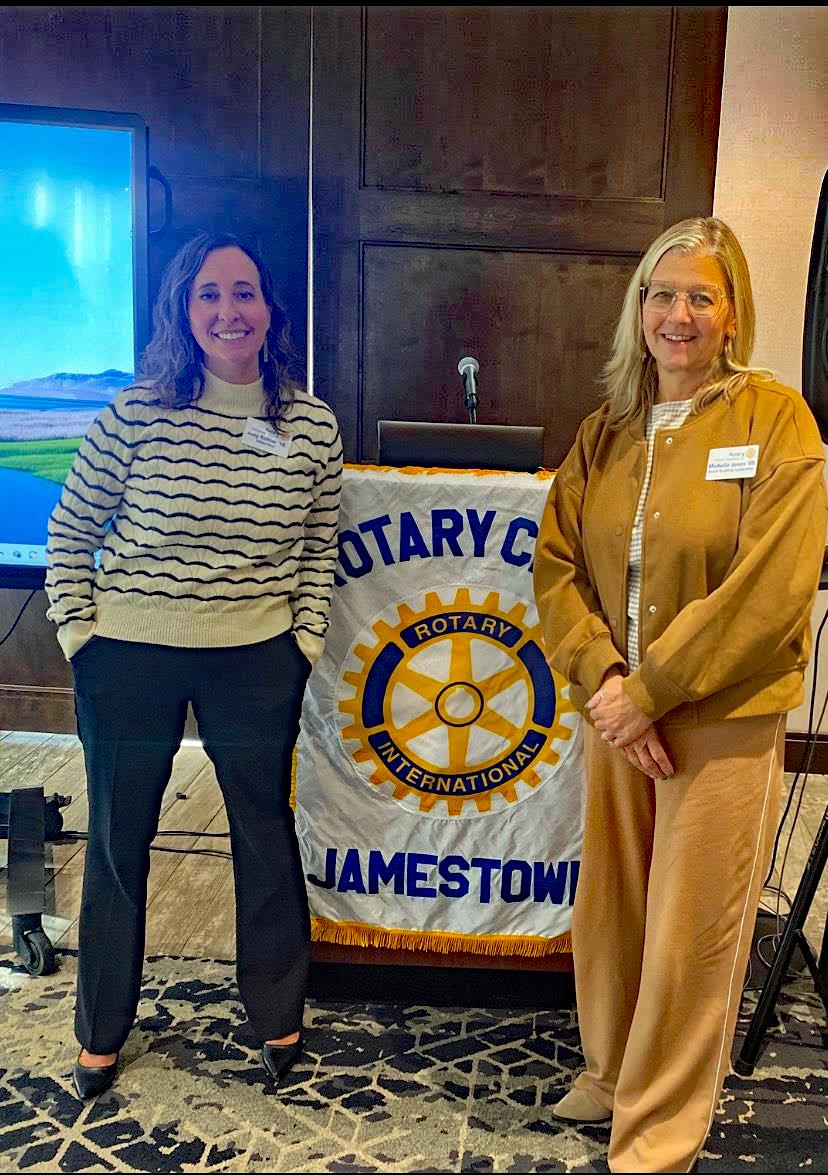 And on October 27, the club’s guest speaker was Amy Rohler, a fellow Rotarian and Executive Director of the United Way of Chautauqua County. Amy delivered an insightful presentation on ALICE, an acronym that stands for “Asset Limited, Income Constrained, Employed” and is used to describe many individuals who live in the Jamestown and Chautauqua region.
Amy noted that the ALICE population represents working families who earn above the federal poverty level but still struggle to meet basic living expenses. These households may not own a home or a car, often lack savings, and live just one unexpected emergency away from financial crisis. Though they are employed—either full-time or part-time—their wages are insufficient to cover essential needs such as housing, childcare, transportation, healthcare, and food.
In Chautauqua County, there are approximately 55,000 households, and 46% live below the ALICE threshold—meaning nearly half of all families are struggling financially. This includes 16% living below the federal poverty level and 30% identified as ALICE.
To help communities, employers, and service organizations better understand these struggles, United Way developed The ALICE Experience about three years ago. Amy said the organization will provide a two-hour, hands-on workshop for employers and their staff, which simulates the real-life budgeting challenges faced by ALICE families.The goal of the exercise is to provide participants with a firsthand understanding of the stress and complexity of living paycheck to paycheck. After the simulation, many describe feeling anxious, sad, or overwhelmed—a powerful reflection of what ALICE families experience every day.
Amy indicated that the United Way of Chautauqua County has shared the ALICE Experience widely, engaging leaders and employees across multiple sectors to build empathy and awareness.
Beyond the ALICE initiative, the United Way of Chautauqua County continues to support 38 agencies countywide and provides a variety of other important services as well.
PHOTO (L to R): Amy Rohler, Rotarian and executive director of the United Way of Chautauqua County and Michelle Jones, Rotary Club of Jamestown president.